


Free, prior and informed consultation (FPIC) in Honduras: a guide for projects
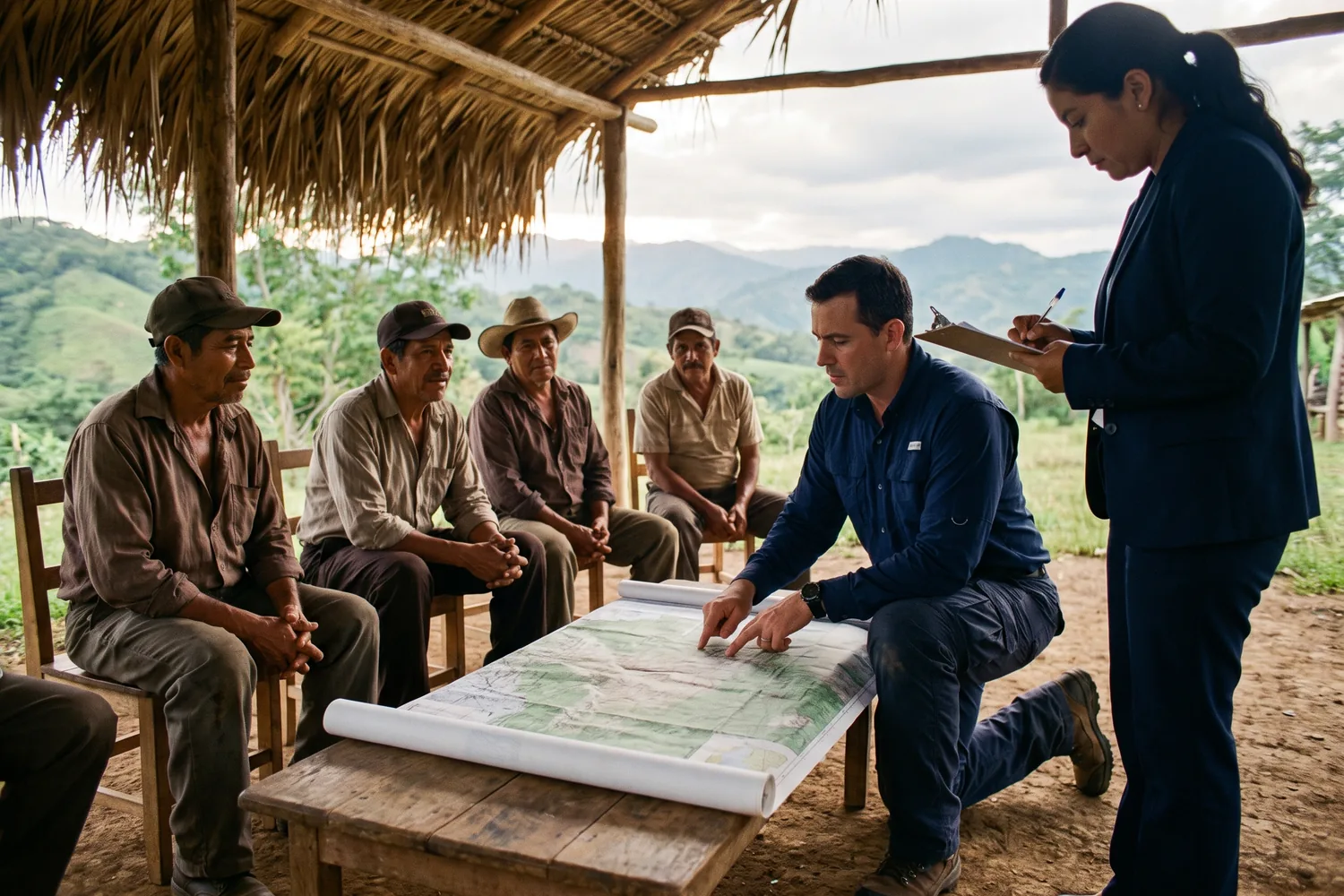
Executive summary — Free, prior and informed consultation is the right of Indigenous and Afro-Honduran peoples to take part in decisions that affect them directly - not a formality within the environmental file. Honduras has no statute regulating the procedure, yet the duty remains enforceable through ILO Convention 169, Inter-American Court case law and international lending standards. This guide explains what makes a consultation valid, when the standard requires consent rather than dialogue alone, how it connects to licensing before MiAmbiente, and what a record must contain to survive an audit.
What free, prior and informed consultation and consent means
Free, prior and informed consultation and consent (FPIC) is the right of Indigenous and Afro-descendant peoples to be consulted, through appropriate procedures and via their own representative institutions, whenever administrative or legislative measures are contemplated - or projects authorized - that may affect them directly. In project terms, that right translates into a structured dialogue process that must take place before irreversible decisions are made about the design, siting or authorization of the works.
The qualifiers attached to the word consultation are not rhetoric. Each one is a verifiable requirement, and the absence of any of them compromises the validity of the entire process.
- Prior - before the decision being consulted upon, not after a design has been finalized and not concurrent with construction.
- Free - without coercion, pressure, intimidation or incentives that distort the community's internal deliberation.
- Informed - with sufficient, accurate, timely and culturally accessible information, in the language of the people consulted, covering adverse impacts and risks and not only benefits.
- In good faith, with the aim of reaching agreement - a genuine dialogue capable of influencing the decision, not a one-way information session.
The most expensive misunderstanding we see in Honduran projects is treating FPIC as a community relations activity or as a documentary requirement of the environmental file. It is neither: it is a third-party right grounded in international law, and failing to honour it creates legal, financial and reputational exposure that outlives the licence.
The legal framework that applies in Honduras
Honduras has no general statute regulating the consultation procedure. The draft bills discussed in recent years have not reached consensus with Indigenous and Afro-Honduran organizations, so the domestic regulatory gap remains. That gap does not remove the obligation; it shifts it onto the sources that are enforceable.
- ILO Convention 169 on Indigenous and Tribal Peoples - ratified by Honduras in 1995. It is the principal source of the duty to consult and of the requirement that consultation take place through the peoples' own representative institutions.
- The United Nations Declaration on the Rights of Indigenous Peoples (2007) - reinforces the standard and consolidates the notion of consent where impacts are severe.
- Inter-American Court of Human Rights case law - the Honduran State has been found responsible in cases concerning Garifuna communities, among them Garifuna Community of Punta Piedra and Garifuna Community of Triunfo de la Cruz, both decided in 2015. These rulings set concrete obligations on collective property and consultation that bear directly on projects along the north coast and in areas subject to communal titling.
- Peoples' own consultation protocols - several peoples have developed their own instruments. The most consolidated example is the biocultural protocol produced by the territorial structure of the Miskitu people in La Moskitia, which defines who decides, on what timelines and under which rules within that territory.
The practical consequence for a developer is straightforward: the absence of national regulations is not a licence to improvise. The applicable standard is assembled from Convention 169, Inter-American case law, the affected people's own protocols and, where international financing is involved, the lender's safeguards.
Consultation and consent: where the line falls
The general rule is good-faith consultation aimed at reaching agreement or obtaining consent. In certain circumstances, however, the standard rises and consent stops being a desirable outcome and becomes a condition. The distinction is decisive because it determines what happens when no agreement is reached.
The three heightened circumstances, recognized both in Inter-American case law and in international lending standards, are:
- Relocation of communities away from their traditional lands and resources.
- Storage or disposal of hazardous materials on lands or territories under traditional ownership, occupation or use.
- Large-scale development or investment plans with significant impacts on the territory, on the natural resources on which subsistence depends, or on critical cultural heritage.
Outside these circumstances, the absence of agreement does not automatically halt a project, but it does require the developer to document how the community's observations were considered and what changed as a result. A process in which nothing changed after listening to the community is, in practice, evidence that the consultation was not conducted in good faith.
Who must be consulted, and who carries the duty
Honduras recognizes nine Indigenous and Afro-Honduran peoples: Lenca, Maya-Chorti, Tolupan, Pech, Tawahka, Miskitu, Nahua, Garifuna and English-speaking Black communities. Their territorial presence is extensive and does not always match the municipal boundaries a developer uses to draw its area of influence. Correctly determining the presence of these peoples is therefore the first technical decision of the process, and it forms part of the social component of the environmental and social impact assessment.
On the question of who consults, two planes are routinely conflated:
- The legal duty to consult rests with the State. It is a non-delegable obligation under Convention 169; a private developer cannot substitute for the State nor validate a deficient process on its own authority.
- The developer's responsibility is autonomous and parallel. Under international performance standards, the developer must conduct an informed participation process and, in the heightened circumstances, demonstrate that consent exists. Pointing to State inaction does not remove the risk from the project.
A third recurring error concerns the counterpart. Consultation must be channelled through the representative institutions the people themselves recognize - territorial councils, federations, traditional authorities - not through whichever structures prove most accessible or most favourable to the project. Negotiating with a counterpart that lacks internal legitimacy produces agreements that collapse precisely when the project is most exposed.
The conditions that make a consultation valid
A defensible FPIC process - defensible before an authority, a court or a lender - satisfies a set of conditions simultaneously. Meeting most of them is not enough.
- A real opportunity to influence - consultation happens while design, routing or siting alternatives are still open.
- Complete, comprehensible information - project description, expected adverse impacts, mitigation measures, risks and uncertainties, delivered in the people's language and in culturally appropriate formats.
- The community's own timelines - respect for internal deliberation periods, which rarely align with the project schedule.
- Culturally appropriate procedure - venue, format, interpretation, and the participation of women and young people according to the norms of the people consulted.
- Absence of pressure - no conditioning of social benefits on acceptance of the project, and no fragmentation of the community through individual agreements.
- Full record - minutes, attendance lists, materials distributed, questions asked and answers given, with agreements and disagreements both on record.
- Continuity - consultation does not end when minutes are signed; it is sustained through construction and operation via an accessible grievance mechanism.
How FPIC connects to environmental licensing
The assessment process before the National Environmental Impact Assessment System (SINEIA) includes public participation and project disclosure stages, which MiAmbiente's Environmental Assessment and Control Directorate (DECA) weighs as part of the file. It is essential to understand that completing that stage is not equivalent to having carried out prior consultation under Convention 169. They are distinct obligations, with different legal bases, different addressees and different standards.
Environmental disclosure is directed at the population of the area of influence in general and sits within an administrative procedure. FPIC is directed at collective rights-holders and is governed by a human rights standard. A project can hold an impeccable disclosure record and still face a challenge for consultation not performed.
In practice, the sequence that reduces risk is the following:
- Early identification of Indigenous and Afro-Honduran presence in the area of influence, before the design is fixed.
- Mapping of actors and legitimate representative structures, including a review of any existing self-determined protocols.
- Agreement on the methodological route for the consultation with those representative institutions, before substantive dialogue begins.
- Substantive consultation on impacts, measures and alternatives, informed by the social baseline of the environmental study.
- Verifiable incorporation of the results into the design, into the environmental and social management plan and into the file submitted during the environmental licensing process.
Where a project also affects sites of cultural or archaeological value, the process must be coordinated with the remit of the Honduran Institute of Anthropology and History (IHAH); where it touches protected areas or forest, with that of the Forest Conservation Institute (ICF). Consultation does not replace those procedures, but a late finding in any of them usually reopens the dialogue with the community.
What international lenders require
For internationally financed projects, FPIC has long ceased to be discretionary. The frameworks applied by banks, funds and global operators incorporate the standard explicitly and turn it into a contractual condition.
- IFC Performance Standard 7 (Indigenous Peoples) - requires a process of informed consultation and participation and, in the three heightened circumstances described above, the free, prior and informed consent of the affected communities.
- IFC Performance Standard 1 - requires an environmental and social management system with stakeholder engagement and an operational grievance mechanism throughout the project cycle.
- The Equator Principles - the framework many financial institutions apply to assess environmental and social risk in project finance, which refers back to the Performance Standards in non-OECD countries.
Under these schemes, the evidence of the process matters as much as the process itself. A weak consultation record can hold back disbursements, trigger contractual clauses or stop a financing transaction outright. Aligning the process with these frameworks from the outset - rather than reconstructing it after the fact to satisfy a review - is the work we handle as alignment with international standards.
Common errors that invalidate a consultation
Processes that fail rarely do so because of a single serious defect; they erode through an accumulation of apparently minor decisions. The patterns that recur most often are:
- Consulting late - starting the dialogue once design, routing and schedule are already fixed. The defect is structural and cannot be cured with more meetings.
- Confusing disclosure with consultation - presenting the project at an information session and filing the attendance list as proof of consent.
- Choosing the counterpart - negotiating with structures that lack representativeness recognized by the people themselves.
- Informing asymmetrically - describing benefits in detail while presenting adverse impacts in vague or impenetrably technical terms.
- Conditioning benefits - tying social works, employment or support to acceptance of the project, which vitiates the free character of the process.
- Closing the process at signature - failing to follow up on agreements or to keep a grievance channel operating through construction and operation, which is when real conflicts emerge.
From process to record: what must be documented
A well-conducted but poorly documented consultation is indefensible before a court, an audit or a lender. The consultation record is the asset that allows a project to demonstrate, years later, that it acted to standard. At a minimum it should contain:
- The identification analysis of peoples and communities present in the area of influence, with its technical basis.
- The agreed methodological route and evidence of its validation with the representative institutions.
- The information materials delivered, including translated versions and adapted formats.
- Minutes of every session, recording questions, answers, observations and disagreements without editing.
- The traceability matrix linking each community observation to the decision taken: what was incorporated, what was not and why.
- The agreements signed and their compliance plan, with owners, deadlines and verifiable indicators.
- The operating record of the grievance mechanism, with response times and case closure.
That record is not filed away - it is audited. As with the conditions attached to an environmental licence, the social commitments made during consultation form part of the continuous compliance verified across the life of the project. An unmet community commitment has the same effect as an unimplemented mitigation measure: it turns a valid process into an open contingency.
FPIC is demanding in time and method, but it is rarely the factor that stops a project. What stops projects is having done it late, badly or only in appearance. If your project sits in an area with Indigenous or Afro-Honduran presence, the moment to design the process is before the works are designed: let us discuss your specific case.
How ACQUA supports consultation processes
We design and conduct engagement and consultation processes with integrated technical-legal judgment, aligned to the international standard and auditable from beginning to end.
- Community and stakeholder consultation — actor mapping, an agreed methodological route, facilitation of the dialogue and systematization of the record.
- Environmental and Social Impact Assessments — social baseline and impact assessment that give the consultation its technical foundation.
- International standards — alignment with the IFC Performance Standards, the Equator Principles and multilateral lending safeguards.
- Regulatory compliance — follow-up on signed agreements and operation of the grievance mechanism across the life of the project.
Frequently asked questions
What is free, prior and informed consultation and consent (FPIC)?
It is the right of Indigenous and Afro-descendant peoples to be consulted, through their own representative institutions, before measures or projects that may affect them directly are authorized. It must be prior to the decision, free from pressure, informed by complete data on adverse impacts, and conducted in good faith with the aim of reaching agreement. It is not an information session, nor a community relations activity.
Is there a prior consultation law in Honduras?
Honduras has no general statute regulating the consultation procedure; the draft bills discussed in recent years have not reached consensus with Indigenous and Afro-Honduran organizations. The obligation nonetheless remains enforceable through other sources: ILO Convention 169, ratified by Honduras in 1995, the case law of the Inter-American Court of Human Rights, and the consultation protocols developed by the peoples themselves.
When is consent required rather than consultation alone?
The international standard raises the requirement from consultation to consent in three circumstances: relocation of communities away from their traditional lands, storage or disposal of hazardous materials within their territories, and large-scale development plans with significant impacts on the territory, on subsistence resources or on critical cultural heritage. Outside those circumstances, good-faith consultation aimed at agreement applies.
Does project disclosure under SINEIA replace prior consultation?
No. The public participation stages within the environmental assessment process reviewed by MiAmbiente's DECA are directed at the population of the area of influence in general and belong to an administrative procedure. Prior consultation is directed at collective rights-holders and is governed by a human rights standard. A project can complete disclosure and still face a challenge for consultation not performed.
What do international lenders require regarding consultation?
IFC Performance Standard 7 requires a process of informed consultation and participation with Indigenous peoples and, in the three heightened circumstances, free, prior and informed consent. Performance Standard 1 adds the requirement of a management system with an operational grievance mechanism. The Equator Principles refer back to these standards, so a weak consultation record can hold back disbursements or stop financing.
Is your project located in an area with Indigenous or Afro-Honduran presence? ACQUA designs and conducts consultation processes to the international standard, producing the record your lenders and the authority will later demand. Request an initial conversation →
Last updated: September 1, 2026 · ACQUA Corporation, Tegucigalpa, Honduras.